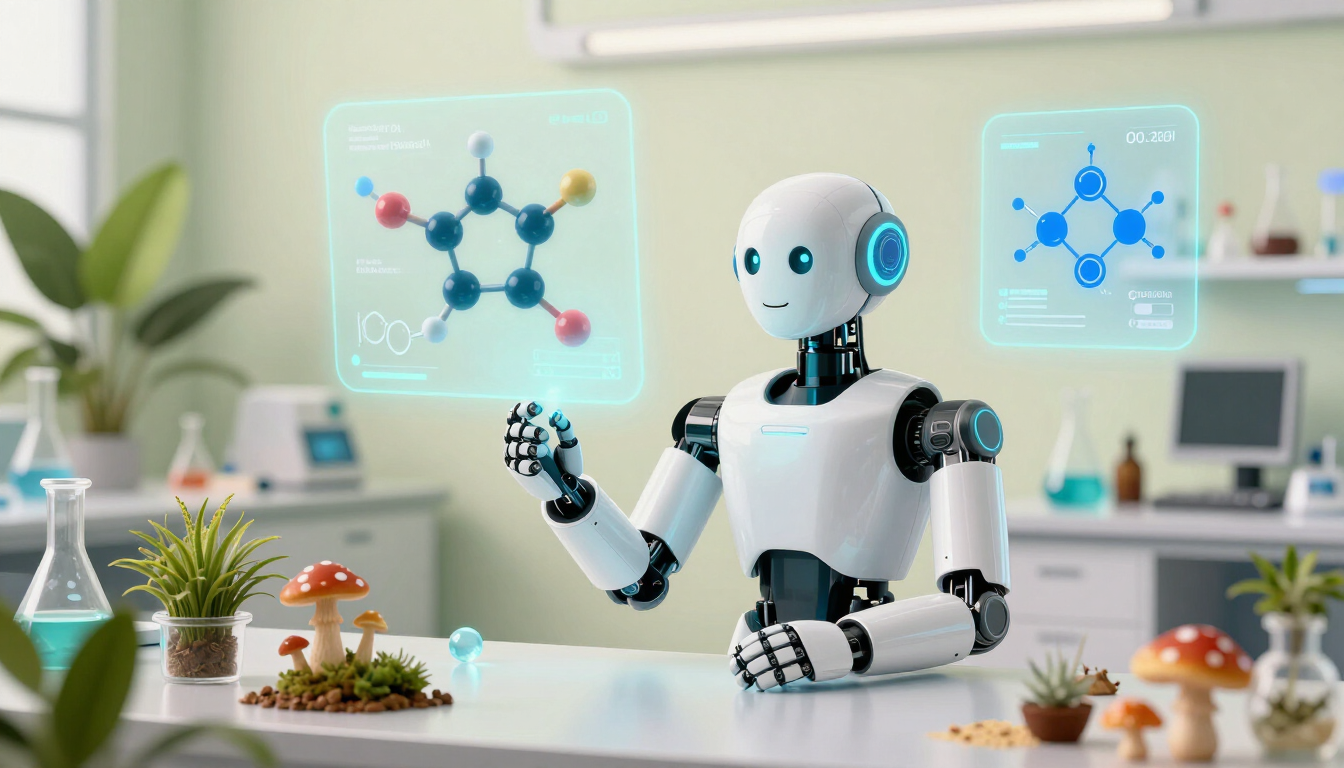
Imagine you have a giant box of LEGO bricks made from plants, mushrooms, and other living things. For thousands of years, people have mixed a few of those bricks together to make medicines that help the brain stay sharp or calm the body under stress. Those mixes are called nootropics (brain helpers) and adaptogens (stress balancers).
Now picture a super-smart robot that has looked at every LEGO brick ever found in nature, learned the rules of how they snap together, and can invent completely new bricks and brand-new combinations that nobody has ever seen or sold before. That robot is generative AI. And it is already changing how we discover natural compounds for better focus, memory, mood, and resilience — a frontier you can explore hands-on through the AI supplement finder.
This is the story of how generative AI finds and designs novel molecules from natural sources — and why the next wave of nootropics and adaptogens will look nothing like today's catalogs.
What Are Nootropics and Adaptogens? (Explained Like You're 8)
Nootropics are natural or nature-inspired helpers that make your brain work a little better — clearer thinking, better memory, smoother focus. Think of them as gentle fuel for the thinking parts of your brain.
Adaptogens are special plant or mushroom helpers that help your body handle stress without crashing. They act like a thermostat: if stress is too high, they help bring it down; if energy is too low, they help lift it gently.
Most of what you buy today comes from the same few plants people have used for centuries: Bacopa for memory, Rhodiola for energy under stress, Lion's Mane for nerve growth, Ashwagandha for calm, etc. The problem? Nature has made millions of other compounds we have barely explored. And almost no one has systematically designed brand-new combinations that nature never mixed — a gap that matters for anyone managing their general health and wellness.
The Old Way Was Slow and Limited
Traditional discovery worked like this:
1. Collect plants or fungi.
2. Extract compounds one by one.
3. Test them in labs (expensive and slow).
4. Hope something useful appears.
High-throughput screening of natural compounds usually gives hit rates below 1% — often as low as 0.01–0.1%. Screening 100,000 compounds can take days or weeks and cost serious money per sample. Most of the chemical space of natural products stays unexplored. Catalogs stay full of the same familiar ingredients.
How Generative AI Actually Works (Still Simple)
Generative AI models learn the "language" of molecules the same way language models learn English. Molecules can be written as strings (SMILES) or graphs. Chemical language models and diffusion models train on huge libraries of known natural products. Then they generate new ones that look natural-product-like but have never been isolated or sold — part of the same wave of AI in healthcare and discovery that is accelerating research across the field.
They can:
- Propose completely new molecular scaffolds inspired by nature.
- Optimize existing natural compounds for better activity or fewer side effects.
- Predict how two or more compounds will work together (synergy).
- Check synthesizability or natural abundance so the ideas are realistic.
The AI is not randomly inventing fantasy molecules. It stays close to the chemical rules and patterns that evolution already used, then explores the empty spaces between known compounds.
Real Numbers: AI vs Traditional Discovery
Here is what recent platforms have actually delivered:
| Metric | Traditional High-Throughput Screening | AI-Driven Natural Compound Discovery (example: NYB Vecura / LigoSPACE pipeline) |
|---|---|---|
| Hit rate | Often 0.01–0.1% (rarely above 1%) | Up to 64× higher |
| Time to identify high-potential compounds | Months to years | 5 months for 3,500 candidates |
| Compound library size explored | Limited by physical samples | 700,000 → 1.5+ million digitized natural compounds |
| Coverage vs known databases | Baseline | ~7× broader |
| Speed of discovery + early validation cycle | Baseline | ~6× faster |
| Focus area relevant to brain health | General | 156 neuromodulatory receptors and transporters |
In one documented case, an AI platform screened a Southeast Asian natural compound library and surfaced 3,500 compounds with high predicted bioactivity and low toxicity for mental wellness targets in roughly five months — work that would have taken traditional labs years.
Znajdź suplementy bez recepty w ciągu kilku sekund
Wpisz produkt, składnik lub kategorię, aby przeszukać repozytorium.
Other platforms (including Brightseed's Forager) have mapped tens of millions of natural compounds and linked them to specific biological pathways, then moved selected bioactives into clinical validation. Generative models are also creating novel natural-product-like derivatives (for example, new guaianolide sesquiterpene analogs designed with transfer learning and generative models that later showed potent activity in lab tests).
Designing Combinations That Do Not Exist in Any Catalog
Single new molecules are powerful. Combinations are where the real magic happens for nootropics and adaptogens.
AI can now:
- Score thousands of possible pairs or triples for synergy, safety, and complementary mechanisms (one compound supports nerve growth factor, another modulates stress hormones, a third improves blood flow or mitochondrial function).
- Avoid known negative interactions.
- Generate novel multi-compound formulas that have never been tested or sold together.
Imagine an AI proposing a never-before-seen trio: a new Lion's-Mane-inspired erinacine analog + a rare adaptogenic sesquiterpene from a tropical plant + a mild natural compound that gently supports dopamine signaling — all predicted to work together better than any existing stack, with better safety margins and higher bioavailability. That combination does not exist in current catalogs. Generative systems are already exploring exactly this kind of whitespace — and it pairs naturally with the rise of AI health personal agents becoming part of everyday life that tailor such formulas to the individual.
Researchers are also using AI to mine literature for known synergies and then systematically generate the missing combinations that no one has tested yet. The chemical and biological space of possible natural product combinations is enormous. AI is the first tool that can navigate it at scale.
Concrete Examples of What Generative AI Is Already Doing
- Chemical language models trained on natural products propose novel natural-product-like scaffolds that expand the explored chemical space far beyond what exists in databases.
- Generative models constrained to stay synthesizable or biosynthetically plausible create candidates that chemists can actually make or that plants/microbes could produce.
- Platforms focused on neuromodulatory targets have delivered large sets of natural compounds ranked for activity on serotonin, dopamine, GABA, and glutamate pathways — the exact systems nootropics and adaptogens care about.
- In related fields, generative AI has designed completely new molecules (antibiotics, enzyme inhibitors, protein binders) that later worked in the lab, proving the approach is not science fiction — and complementing other AI clinical tools now entering routine practice.
The same engines are now being pointed at cognitive and stress-resilience targets.
Why This Matters More Than Just "Cool New Molecules"
Today's nootropic and adaptogen market is crowded with the same 10–15 ingredients. Differentiation is hard. Clinical evidence is often thin. Consumers want better results with cleaner labels.
Generative AI + large natural compound libraries changes the economics:
- Faster path from idea to validated candidate.
- Ability to create proprietary, patentable combinations that competitors cannot simply copy from existing catalogs.
- Better prediction of safety and mechanism before expensive human trials.
- Potential for more precise, multi-target formulas instead of shotgun megadoses of single herbs.
The companies that master this will not just launch another Bacopa + Rhodiola blend. They will launch the first truly novel natural-inspired cognitive and resilience formulas designed by machine intelligence and validated by modern biology — a direction OTC Supps is watching closely as it reshapes how people choose supplements.
Challenges That Still Exist (Honest Version)
Data quality for natural products is still uneven. Many traditional knowledge sources lack modern pharmacological annotations. Generated molecules still need wet-lab confirmation. Regulatory pathways for completely novel combinations require careful safety work. And "natural" does not automatically mean safe — AI predictions must be tested.
These are solvable engineering and scientific problems, not fundamental barriers. Progress between 2024 and 2026 has been rapid.
The Bottom Line
Generative AI is turning the vast, mostly unexplored chemical library of nature into a designable space. For nootropics and adaptogens, this means we are moving from "what plants have people used for a long time?" to "what novel molecules and combinations can we design that nature could have made but never did — optimized for human brain health and stress resilience?"
The catalogs of 2030 will contain ingredients and stacks that do not exist today. Many of them will have been first imagined by generative models trained on natural compounds.
The best brain and resilience formulas of the future will not be rediscovered. They will be designed.


