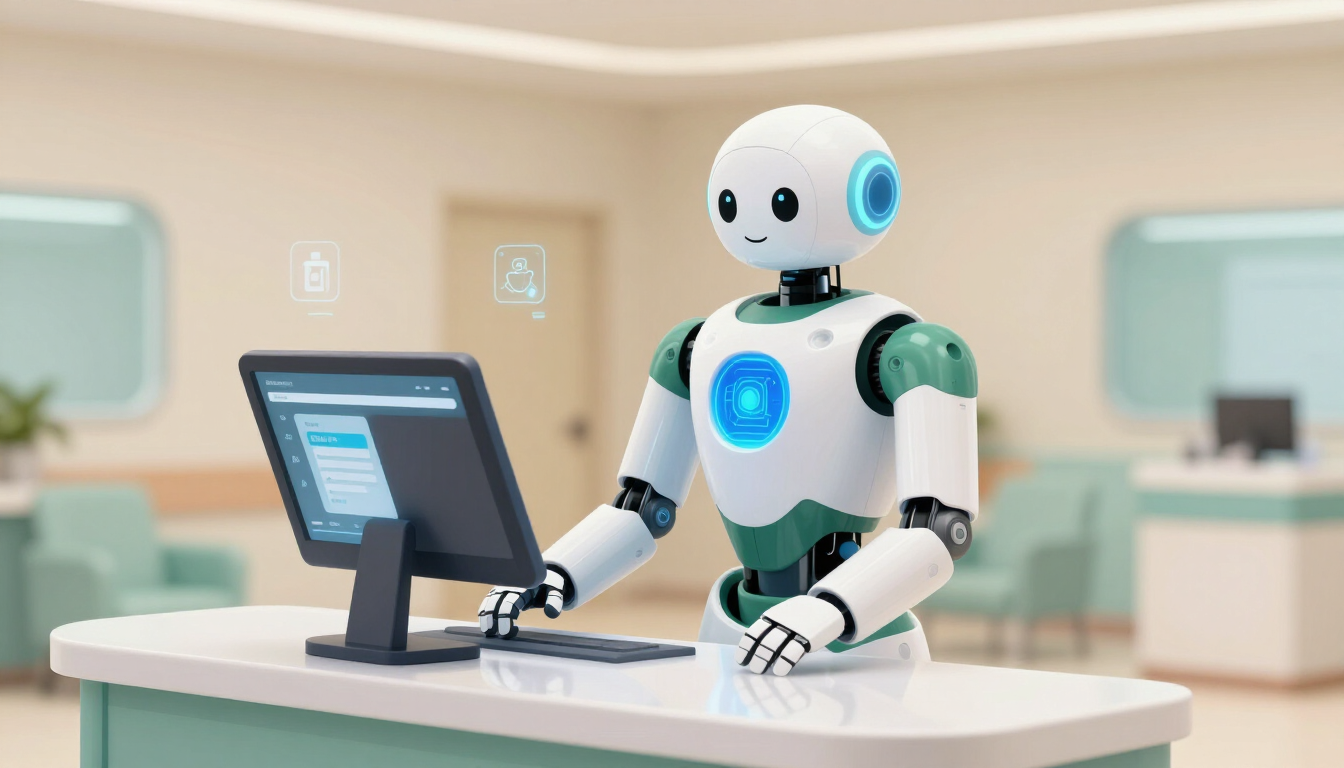
Imagine walking into a hospital with a broken arm. You are in real pain. Maybe you also have a seafood allergy from that unfortunate Red Lobster dinner last month. You need help now.
What greets you instead? The registration desk.
You wait. Staff ask the same questions over and over. They hand you a stack of paperwork: name, date of birth, insurance, chief complaint, allergies, medications. Your arm throbs. Every minute feels longer. Patients in agony often become short-tempered or aggressive — not because they are bad people, but because the system forces them to perform administrative tasks while suffering. This is not care. This is a bottleneck that exists in almost every hospital on Earth.
Now picture the opposite.
You walk in. Big interactive screens stand where the desk used to be — the same style of self-order kiosks you already use at McDonald's. The system welcomes you quietly. You press Start. Instead of typing, you simply speak:
"I fell off my bike and broke my arm. I need treatment fast."
The AI listens. It asks only what it needs. Then it says: "Please scan your ID." You place your driver's license (or national ID card) on the scanner. In seconds the system pulls your complete medical record — allergies, previous injuries, current medications, insurance. It flags the seafood allergy automatically. It identifies the next available doctor, pushes the full patient file and situation summary to that doctor's tablet or medical watch, and directs you straight to the right area. No forms. No repeated questions. No human bottleneck. Quiet. Fast. Accurate.
This is not science fiction. This is the clear next step for hospital operations and part of the broader wave of generative AI already changing healthcare operations in 2026. The traditional registration desk is the first thing that must be replaced by AI.
The Real Cost of the Human Registration Desk
Emergency departments worldwide already struggle with long waits. Registration is often the first delay patients experience while in pain.
Here is a snapshot of average emergency department waiting times across countries (various 2023–2025 data sources):
| Country | Approximate Average ER Wait Time |
|---|---|
| Brazil | 195 minutes |
| Italy | 164 minutes |
| Australia | 159 minutes |
| France | 141 minutes |
| Canada | 126 minutes |
| United Kingdom | 112 minutes |
| South Africa | 120 minutes |
| United States | ~24–162 minutes (median often ~2.5 hours total visit) |
| Germany | 22 minutes |
| Japan | 35 minutes |
| South Korea | 48 minutes |
| Sweden | 38 minutes |
These numbers include the full experience, but the registration and initial paperwork phase is a consistent early friction point. Patients routinely report standing or sitting in pain while clerks search systems, correct handwriting errors, and process paper forms.
Manual data entry carries high error rates. Studies show paper-based intake produces roughly 20% data entry errors. Digital systems drop that figure to around 0.67%. Demographic and technical mistakes account for about 61% of healthcare claim denials. Every error creates downstream delays, wrong records, or billing problems.
Hospitals also spend heavily on administration. In the United States, hospital administrative costs have reached nearly twice the spending on direct patient care in recent analyses. Front-desk and registration labor is a visible part of that overhead. Staff spend hours on repetitive data collection instead of supporting clinical work.
Patients in pain are not at their best. The combination of physical agony and bureaucratic friction produces friction, raised voices, and lower satisfaction scores across systems.
How an AI Hospital Registration Desk Actually Works
The vision is simple and already partially proven in pilots:
1. Patient approaches a large interactive screen or dedicated kiosk (McDonald's-style, wheelchair accessible, multi-language, voice-first).
Find Over The Counter Supplements in Seconds
Enter a product, ingredient, or category to search the repository.
2. Voice conversation begins. The AI asks focused clinical and administrative questions in natural language.
3. Patient scans government ID or insurance card. Facial recognition or biometric confirmation can add a second layer where regulations allow.
4. System instantly retrieves the electronic health record, allergy list, medication history, and insurance eligibility.
5. AI performs basic triage prioritization and notifies the next available clinician with a complete, structured summary on their tablet or wearable device.
6. Patient receives clear next-step instructions (wait area, imaging, treatment bay) without further paper.
The entire interaction can take under two minutes for returning patients and only a few minutes longer for new ones. Staff are freed for complex cases, emotional support, or clinical tasks that actually require a human — a shift that pairs naturally with the rise of AI health personal agents becoming part of everyday life.
Real-World Examples Already Moving in This Direction
- Vietnam (Da Nang Hospital): Smart medical kiosks using citizen ID cards and facial recognition cut registration to about one minute. Patients no longer wait for queue numbers to be called.
- Canada (Ontario health system pilot): Self-service kiosks in emergency departments delivered 2–4 minutes of staff time savings per patient. Registration process shortened by nearly 46 seconds on average; triage nurse time dropped by over a minute.
- Hong Kong: Smart A&E enquiry kiosks reduced the number of questions handled by human counters by 38–56% in the first weeks of use.
- Thailand (Bangkok Hospital): AI-driven patient flow and queue systems cut average wait times by 59% in a major health check center while raising staff satisfaction.
- Czech Republic (Brno Children's Hospital): AI digital reception with natural voice and avatar reduced staff time spent answering basic navigation and process questions.
- United Arab Emirates: Emerging smart clinic pods use national ID to pull records and capture vitals without a nurse at the first step.
- Multiple U.S. health systems have deployed large fleets of check-in kiosks that cut new-patient intake from ~25 minutes to 5–7 minutes and returning-patient check-in to roughly two minutes.
These are not full voice-AI medical registration desks yet, but they prove the direction works. Patients accept the technology quickly when it is reliable and faster than the human line.
Traditional Desk vs AI Registration Desk
| Aspect | Traditional Human Desk | AI Registration Desk |
|---|---|---|
| Time for basic registration | Often 10–25+ minutes (queue + forms) | 1–5 minutes |
| Data accuracy | High error rates from handwriting/typos | Near real-time pull + patient confirmation |
| Allergy / history retrieval | Manual search or patient recall | Instant from electronic record |
| Staff workload | High repetitive data entry | Focus on complex cases and care |
| Patient experience in pain | Frustrating, repetitive, slow | Quiet, fast, dignified |
| Scalability at peak hours | Limited by staff numbers | Multiple kiosks handle surge without fatigue |
| Downstream effect | Delayed clinician notification | Immediate structured alert to available doctor |
Why This Must Be the Priority
Hospitals do not need AI to replace doctors or nurses first. They need AI to remove the administrative friction that sits between a patient in pain and the clinician who can help. The registration desk is the most visible, most universal, and most solvable bottleneck.
When the system works, three things happen at once:
- Patients in genuine distress reach care faster.
- Clinicians receive cleaner, more complete information sooner.
- Hospitals reduce administrative waste and free human staff for higher-value work.
The technology already exists in pieces: large touchscreens, reliable ID scanning, electronic health record integration, voice AI, and secure clinician notification systems. What remains is deliberate hospital leadership that treats the front door of the emergency department as a design problem rather than an inevitable queue.
The future of AI in healthcare does not start with flashy diagnostics or robotic surgery. It starts at the front door — replacing the registration desk with something faster, quieter, more accurate, and more humane.
Patients in pain should never again be asked to fill out paperwork before anyone looks at their injury. That era can end. The AI hospital registration desk is how it ends. For your own personalized health insights and supplement guidance, or to explore general wellness resources, OTC Supps brings the same AI-first approach to everyday health management.


